What Nashville Just Did to create an Airport Express Line to their Music City — and Why Charlotte Should Pay Attention
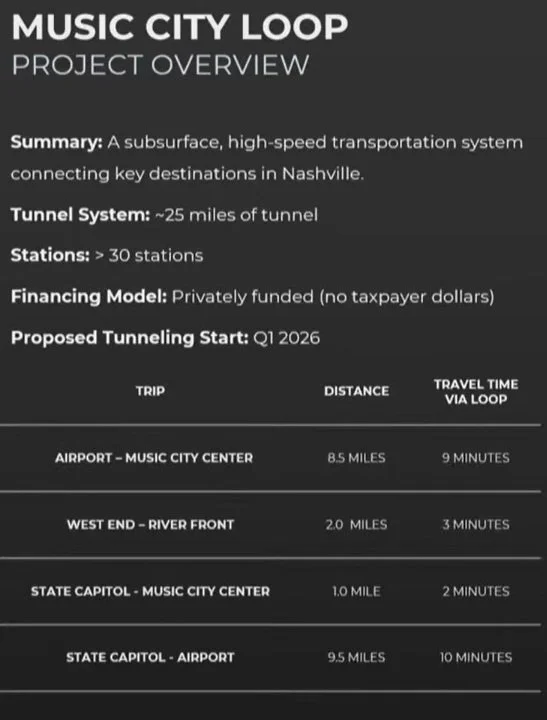
As cities across the U.S. struggle to fund and deliver large-scale transit infrastructure, the state of Tennessee, the Metropolitan Nashville Airport Authority and the Boring Company have quietly introduced a new model—one that could reshape how airport connectivity is built in fast-growing regions like Charlotte.
The recently approved Music City Loop is more than a transit tunnel project. It is a new infrastructure financing model—one where the private sector assumes the risk of construction costs, recouping their investment only once the project is operational.
The Nashville Transit Deal: No Upfront Costs and a share of long term revenues.
At its core, the agreement between the State of Tennessee, the Nashville Airport and the Boring Company is remarkably simple—and disruptive. The Boring company pays for 100% of the capital costs of building, operating and maintaining a public transit line (the Music City Loop) from the Airport to Music City in the center of Nashville.
What the Airport Gets
The Metropolitan Nashville Airport Authority President and CEO emphasized this partnership supports debt payments and future growth, as they aim to reach 40 million passengers at Terminal I and, eventually, expand Terminal II to bring in 70 million passengers. The MNAA said it’s also looking forward to offering another way for travelers to get to and from BNA.
In exchange for allowing “Airport Access”, through tunnel infrastructure and stations on airport property, Nashville International Airport (BNA) receives the following:
1. Guaranteed License Revenue
~$300,000 per year, escalating 3% annually
~$34 million over the life of the agreement (50 years)
2. Per-Ride Airport Access Fees
~$5 per pickup + ~$5 per drop-off (similar to rideshare fees)
Estimated $309+ million in total revenue over the agreement

What the City of Nashville Gets
A 10 minute trip or less from the Airport to the Music City center compared to a 45 minute drive in traffic.
Reduced cars and traffic between Music City center and the Airport.
Reduced emissions from traffic driving to and from the Airport
Increased connectivity to hotels, businesses and entertainment located between the Music City center and the Airport.
The State of Tennessee’s Role
The state receives the economic benefits of the Project by providing:
Long-term underground right-of-way access beneath state owned highways
Issuing permits and lease agreements for the Project properly and on time.
What the Boring Company Gets
Passengers will pay a fare to use Music City Loop transportation system. Fare prices have not been announced, but, as in Las Vegas, are expected to be lower than other transportation options. Stations will be funded by Music City Loop or other private parties, with no use of public funds.
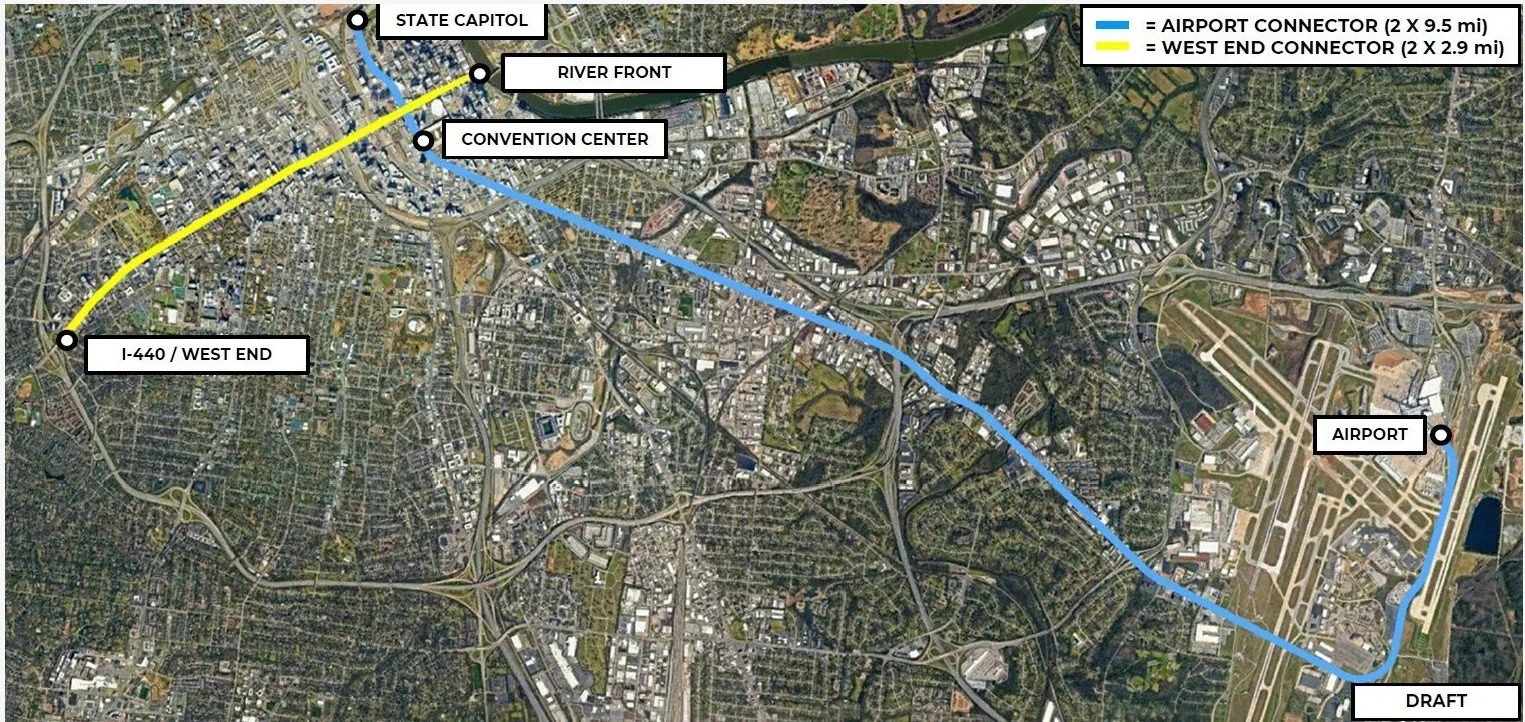
Draft Music City Loop Map
What Can the Charlotte Airport Region Learn
Charlotte has a timely opportunity to consider a 21st-century solution for the planned 28 mile Red Line transit project. An underground system of tunnels with a fleet of electric shuttles could be built under the 100 foot wide right of way corridor recently purchased from Norfolk Southern that connects Davidson to the Uptown Charlotte. Imagine travelling from the town of Davidson to the Charlotte Douglas Airport in just 19 minutes. (from Huntersville to the Airport in 14 minutes). Let’s ask Charlotte’s leaders to accelerate progress, reduce congestion, and create a faster, cleaner, and more affordable link that serves our airport region for decades to come.